Originally published: 01/15/26
Publication: Intersectionality
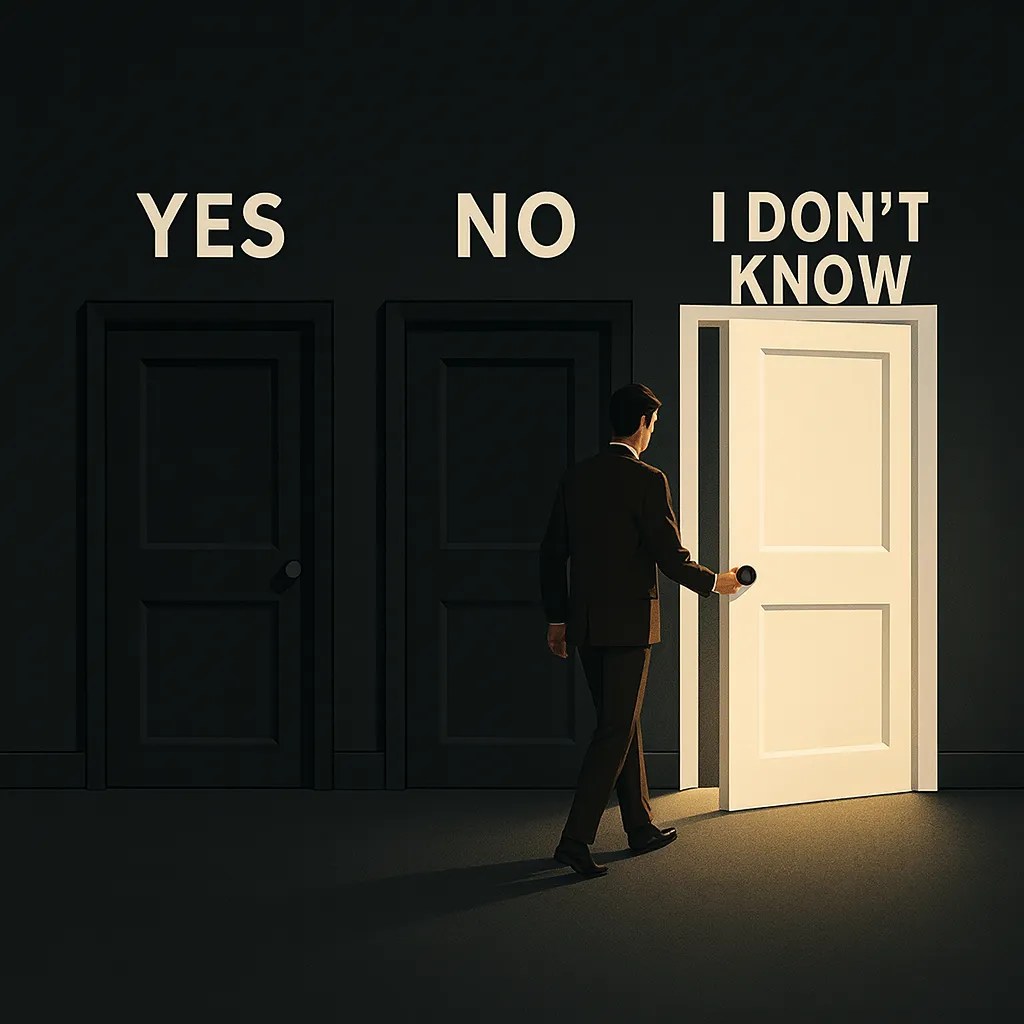
When people talk about belief, they usually act as if there are only two doors in the hallway.
Either you believe, or you don’t. God or no God. Heaven or no heaven. Fate or no fate. You’re for it or against it. Pick one and get on with your day.
For a long time, it bothered me. Not because I had better answers, but because I could feel there was a third door and nobody seemed willing to admit it existed.
The third door is very simple. It’s this:
I don’t know.
Not as a dodge. Not as a shrug. Said plainly:
“I don’t have enough to treat this as real, and I don’t have enough to call it false. So for now, it stays off the control panel.”
That’s the missing setting in most people’s heads. When it’s gone, you’re forced to lie one way or another. Either you pretend you know more than you do, or you pretend you know it’s all nonsense. Both feel decisive. Both are fake.
If you strip it down, every serious claim about reality belongs in one of three boxes.
The first box is for things we know well enough to act on: gravity, germs, cause and effect, the fact that if you walk into traffic you get hit by cars. We’ve tested these. They hold. You’d be a fool to ignore them.
The second box is for things we know well enough to throw away: a flat Earth, microchips in vaccines, the sun going around the Earth. These aren’t “mysteries.” They’re dead ends with “WRONG” stamped on them in very large letters.
The third box is for everything else. Heaven. Reincarnation. “The universe has a plan for me.” The idea that history is secretly on the side of some party or tribe. Things you can’t test, can’t disprove, and can’t distinguish from a hundred competing stories that are just as confident.
Those belong in “I don’t know.” Not halfway believed. Not half-denied. Just unknown.
And here’s the crucial part: if something is in that box, it doesn’t get to steer your life.
You can hope for it. You can enjoy the idea. You can say, “I’d like this to be true.” But you don’t get to build your ethics on it. You don’t get to raise your children as if it were a fact. You don’t get to decide what level of suffering is acceptable for other people because of it.
A sane mind is supposed to keep two tracks separate: what I know and what I want.
A healthy sentence sounds like this:
“I don’t know if there’s a heaven.
I’d like there to be one.
But I can’t honestly say I know.”
That’s a completely livable position. You can work from there. You can love people from there. You can die from there. It doesn’t paralyze you. It just stops you from lying.
The trouble starts when the wires cross.
“I want there to be a heaven” quietly becomes “there is a heaven,” and a moment later it hardens into “I know there is a heaven.” Step by step, desire is promoted to doctrine. After that, you’re not just daydreaming. You’re building.
Once you “know,” you feel justified making decisions on that basis: this life becomes a waiting room, pain becomes “temporary,” injustice becomes “something God will handle later,” and reality right in front of you is treated as less real than the story in your head.
Religion is only one place this happens. The move shows up everywhere.
“I want to believe everything happens for a reason” becomes “everything does happen for a reason,” and now random cruelty has to be explained away as part of some hidden plan. “I want to believe my side will win in the end” becomes “history is on our side,” and now any atrocity can be excused as a necessary step toward destiny. “I want to believe the market will sort everything out” becomes “the invisible hand will fix it,” and now you can ignore obvious failures as temporary ripples in a wise system.
In every case, the honest position was: “I don’t know. I’d like it, but I can’t stand on it.” In every case, that position was rejected because it was uncomfortable.
To be fair, there are two very different ways to say “I don’t know.”
One is lazy: “I don’t know, and I don’t care enough to think about it.” That’s not wisdom. That’s just letting the next loud voice decide for you.
The other is disciplined: “I don’t know, and until there’s real evidence, this stays neutral. It gets zero say in how I live, no matter how attractive it is.”
There’s a simple rule buried in that stance that almost nobody is taught: if I don’t have to make a decision, I don’t. If nothing in my actual life forces me to choose “yes” or “no” on some untestable claim, I leave it in “I don’t know” and move on. In plain terms, I reserve judgment. I don’t promote it to truth just to feel safer, and I don’t swing to the opposite extreme and pretend I’ve disproved it either. I take a position when reality forces my hand, when I have to act. When it doesn’t, the question stays open. That one habit cuts out an incredible amount of fake certainty and keeps my conclusions under my control, not under my fears.
That second version of “I don’t know” is what I mean by the 3rd alternative. It’s closer to a legal plea than a shrug. Not guilty, not innocent, not proven either way. You live with reality as it actually behaves, not as you hope it behaves, and you refuse to decorate your ignorance with a costume and call it faith.
Most of us are never taught how to do this. From early on, “I don’t know” is treated as weak. Teachers want answers. Parents want certainty. Religions and parties want loyalty. So we learn to pick sides where no side is justified.
“Do you believe in heaven?” is treated like a yes/no question. “Do you believe everything happens for a reason?” “Do you believe in God, or fate, or the universe, or the Cause?” Few people feel safe saying, “Honestly? I don’t know.” They’re afraid of disappointing someone: family, tribe, themselves.
So they force a decision. They push a claim with no real evidence into “yes” or “no,” tattoo it on their identity, and then spend the rest of their lives defending a position they never had the information to take.
That’s how you end up with people stating “I know there’s a heaven” and “I know there’s nothing after death” with exactly the same certainty. Neither camp actually knows. Both camps have simply outlawed the third box.
When you throw out “I don’t know,” you’re left with only two tools: dogma and reverse dogma. “It’s true, shut up,” or “It’s false, shut up.” Either way, the conversation is over. So is learning.
Keeping that 3rd alternative alive does the opposite. It lets you act while staying honest. You can say, “Given what I know now, I’m going to live as if this life is the only one guaranteed,” without pretending you’ve settled the metaphysics of the universe. You can still change your mind if something real shows up.
Take heaven as an example. The straightforward truth is that you do not know if heaven exists. If it does, whoever or whatever built this place has clearly not given you public, repeatable evidence of it. You can’t test it. You can’t cross-check it. You have a shelf full of mutually contradictory stories about it from different cultures.
From that, a simple conclusion follows: either there is no heaven, or, if there is one, you are not meant to know about it in any reliable way while you’re here.
In both cases, the result for this life is the same: you cannot use heaven as a foundation. You can want it. You can whisper about it. You cannot legitimately treat it as a known fact that outranks what’s in front of your face.
I’ve lived in that third box for a long time now. On the big untestable questions, I don’t believe and I don’t disbelieve; I live in “I don’t know.” It hasn’t turned me into a nihilist or a robot. I still love people, build things, worry about the future, grieve my dead, and hope there’s more than this. The only difference is I don’t pretend my hopes are facts. Life still works. In a lot of ways, it works better.
From this spot, a lot of what passes for “conviction” in our culture doesn’t look heroic or deep. It looks like a species terrified of saying “I don’t know,” dressing its anxiety up as certainty and then demanding everyone else salute it.
The problem we have now, across religion, politics, economics, and every other tribe, is that we’ve almost forgotten this 3rd alternative exists. We rush to fill every gap with a story, then act shocked when people start living, killing, and voting on top of those stories as if they were granite.
The repair doesn’t start with a new story. It starts with the nerve to say, “I don’t know,” and leave the box open.
Link to original publishing:
https://medium.com/intersectionality/the-3rd-alternative-10ff84107bc0
—
About the author:
Steven Gardner writes essays on culture, technology, and modern incentives.
He has also authored short stories and currently has a novel in the works
More: StevenGardner.com
First published in Intersectionality, January 2026
©2026 Steven Gardner. All rights reserved.


Leave a Reply